
Fraunhofer Consortium develops new standards for tire analysis
Darmstadt, Germany – The “Technology Platform for Tire Abrasion and the Identification of Its Emissions in Road Traffic” (TERIS) project, the Fraunhofer institutes ICT, IGD, and IWM – led by the Fraunhofer Institute for Structural Durability and System Reliability LBF – have reached a decisive milestone. For the first time, the teams aim to generate, analyse, and predict tire wear in the laboratory in a standardized and practical manner. As part of this milestone, results are now available on reference abrasion, particle analysis, tribological models, AI-based surface analysis, a test bench concept, and methods for accelerated aging and VOC detection. The tire industry, testing services, and environmental agencies will in future benefit from reliable, rapid laboratory procedures for emissions assessment
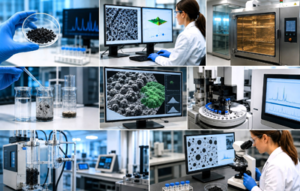
The project is developing new laboratory methods to analyze and predict tire wear under real-world conditions. By combining multiple collection and measurement techniques, researchers can precisely analyze both airborne and deposited tire particles.
Researchers have also developed tribological models that examine how load conditions, material properties, surface characteristics and particle formation interact. The models allow laboratory testing to more closely replicate real-world tire abrasion.
A specialized test chamber for accelerated aging enables researchers to expose tire samples to controlled environmental stress, allowing them to study how weathering affects abrasion behavior in a consistent and repeatable way.
The consortium has also developed an artificial intelligence-powered optical detection system that identifies and classifies surface structures. The technology has been validated using substitute materials and will be tested on rubber samples during the next phase of the project.
In addition, researchers designed a laboratory test bench that combines multiaxial loading to generate tire abrasion, targeted particle detection and integrated optical sensors.
The project also pairs accelerated weathering with chemical analysis of volatile organic compounds (VOCs) released during tire abrasion to evaluate the environmental effects of tire wear particles.
The research is intended to provide a faster and more practical approach for evaluating new rubber compounds in the laboratory. The resulting tools are expected to help tire manufacturers, testing organizations and environmental agencies reduce emissions, accelerate product development and support compliance with Euro 7 emissions requirements.