
August Patents
In the August issue of Rubber World, our editors have listed the following patents from the USPTO.
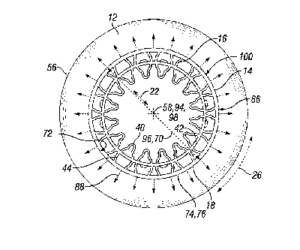
Tire with pressure zero sidewall hoop rings and method of manufacture
U.S. patent: 12,594,792
Issued: April 7, 2026
Inventors: Abraham Pannikottu and Jon Stuart Gerhardt
Assigned: American Engineering Group
Key statement: The invention relates to a pneumatic tire with a toroidal shaped tire carcass having sidewalls and a tread. A typical method of allowing a tire to run even in a punctured state is a method of reinforcing the sidewall area to support the load in the airless state. The present invention discloses both sidewalls having a hoop ring circumferentially molded in place at the middle portion of both sidewalls or as floating multiple hoop rings bonded in place at the middle portion in the tire inside sidewalls for supporting the vehicle load in a run-flat condition.
Dustproof work shoe with antistatic insole using recycled pet- and dustproof rubber outsole capable of being steam sterilized
U.S. patent: 12,588,734
Issued: March 31, 2026
Inventor: Eun Gyum Jeon
Key statement: A dust-proof work shoe using recycled PET, includes: an outsole made of a conductive rubber portion; and an insole being laid on the top of the outsole and having electrical conductivity. The insole is made using a nickel-plated copper fabric in combination with a carbon-graphene yarn and provided in the bottom of the shoe that comes into contact with the foot. The insole is made of recycled PET.
Rubber composition and pneumatic tire using same
U.S. patent: 12,595,319
Issued: April 7, 2026
Inventor: Hironori Miyazaki
Assigned: Toyo Tire
Key statement: Provided is a rubber composition having excellent breaking strength. The rubber composition contains an inverse vulcanizate containing 10 mass % or more of carbon atoms and 30 mass % or more of sulfur atoms.
Enhancement of rubber by heat-assisted migration from ancillary rubber
U.S. patent: 12,595,358
Issued: April 7, 2026
Inventors: Peter H. Mott, Howard L. Schrader and Nickolaus K. Weise
Assigned: The Government of the United States of America, as represented by the Secretary of the Navy
Key statement: A method of restoring an elastomer by providing an article containing a first elastomer and having a surface, contacting the surface with a layer conformal to the surface and applying heat and pressure to the layer. The layer contains a second elastomer and a solute. The heat and pressure induce a transfer of the solute from the layer to the article.
Antiferromagnetic strain recovery induced photon pulse initiating bond cleavage in crosslinked rubber structures
U.S. patent: 12,595,349
Issued: April 7, 2026
Inventor: William B. Coe
Key statement: Crumb rubber obtained from recycled tires is subjected to a process involving photodissociation to break a sulfur bond, sulfur-sulfur and/or sulfur-carbon bonds. The process utilizes a component that generates photonic energy upon being subjected to a compressing force (e.g., pressure). The photonic energy is bandwidth resonant with the sulfur-sulfur and/or sulfur-carbon bond, causing the bond to break apart. The resulting rubber is suitable for use in applications typically utilizing virgin rubber, such as new tires, engineered rubber articles and asphalt rubber for use in waterproofing and paving applications.
Elastomer laminate
U.S. patent: 12,594,745
Issued: April 7, 2026
Inventors: Jose-Carlos Araujo Da Silva, Thomas Ferrand, Emma Moreso and Maxime Pras
Assigned: Michelin
Key statement: An elastomer laminate comprises at least two adjacent layers, the first layer consisting of a composition based on 20 to 100 phr of at least one copolymer comprising ethylene units and units of a formula CH2═CR—CH ═CH2, the ethylene units in the copolymer representing more than 50 mol % of the monomer units, R representing a hydrocarbon chain having 3 to 20 carbon atoms, 0 to 80 phr of at least one diene elastomer having a weight content of diene units of greater than 50%, 10 to 100 phr of a plasticizing system comprising at least one plasticizing resin having a glass transition temperature above 20°C and/or at least one plasticizer that is liquid at 23°C, a reinforcing filler and a crosslinking system and the second layer consisting of a composition based on a diene elastomer having a weight content of diene units of greater than 50% and a crosslinking system.
Active tire auto location systems for tire pressure monitor sensors and operating method
U.S. patent: 12,583,269
Issued: March 24, 2026
Inventor: Chih-Wei Yu
Assigned: Sysgration
Key statement: The present invention provides an Active Tire Auto-Location system for tire pressure monitor sensors and an operating method. The system includes a host, wheel axle rotation detection devices and tire pressure monitor sensors. By allowing the wireless tire pressure detector to receive and compare the rotation information of a toothed ring from the wheel axle rotation detection device and the tire rotation information from the wireless tire pressure detector, each wireless tire pressure detector can identify which wheel axle rotation detection device that corresponds to it. At the same time, the tire position where each wireless tire pressure detector is situated can also be determined. Compared to prior art, it is still possible for the present invention to determine the tire position where each wireless tire pressure detector is situated, without the need for additional modification to the host, thus significantly reducing the inconvenience in replacing tire pressure monitor sensors.
Tire state monitoring system and tire state monitoring method
U.S. patent: 12,583,267
Issued: March 24, 2026
Inventor: Hiromitsu Ichikawa
Assigned: Bridgestone
Key statement: A tire state monitoring system comprises an acquisition device and a control device. The acquisition device is configured to repeatedly acquire a pressure and temperature inside a tire. The control device is configured to: calculate, based on ratios between the pressure and temperature acquired in a first period, a representative value of the ratios in the first period; and compare a ratio between the pressure and temperature acquired in a second period after the first period with the representative value, to determine whether the pressure inside the tire has dropped.
Bulk metallic glass reinforced elastomer for downhole applications
U.S. patent: 12,601,238
Issued: April 14, 2026
Inventors: Shashwat Shukla, Somen Kumar Bhudolia, Sandeep Thatathil and Arpana Singh
Assigned: Halliburton Energy Services
Key statement: In general, in one aspect, embodiments relate to an apparatus that includes a downhole tool, that includes one or more sealing elements that includes a bulk metallic glass (BMG) elastomer composite material.
Composite comprising a metal reinforcing element and an elastomer composition containing an adhesion promoting resin
U.S. patent: 12,600,171
Issued: April 14, 2026
Inventors: Anne-Lise Thuilliez, Odile Gavard-Lonchay, Christophe Le Clerc and Julien Letessier
Assigned: Michelin
Key statement: A composite comprises at least one reinforcing element exhibiting a surface comprising an alloy of copper and zinc, the reinforcing element being embedded in an elastomeric composition based on at least a diene elastomer, a reinforcing filler, a sulfur crosslinking system and a phenol/aldehyde resin based on at least one aromatic polyphenol and on at least one dialdehyde compound comprising two aldehyde functions, in which the content of phenol/aldehyde resin is less than 10 phr.
Impurity removal and modification method for pyrolysis carbon black of waste tires
U.S. patent: 12,600,864
Issued: April 14, 2026
Inventors: Yongxin Duan, Zhengqing Kong, Jie Hu, Ke Liu, Lijuan Zhou and Yunxiao Liu
Assigned: Qingdao University of Science and Technology
Key statement: Disclosed is an impurity removal and modification method for pyrolysis carbon black of waste tires, the method comprising: dispersing pyrolysis carbon black of waste tires in an alkali solution of potassium ferrate; adding hypohalite; leaving to stand for layering; and performing centrifugation and washing on a lower-layer slurry to obtain a stably dispersed pyrolysis carbon black/water suspension. This modification method can be operated simply and easily; and by means of the method, ash in pyrolysis carbon black of waste tires can be effectively removed and the pyrolysis carbon black is then stably dispersed in water. In addition, the modification method is low in production cost and is green and environmentally friendly and a waste liquid thereof can be recycled.
Dental apparatus including a prop and a rubber dam and a method of using the same
U.S. patent: 12,605,229
Issued: April 21, 2026
Inventor: Mohammed Hazaa Alshamrani
Assigned: King Saud University
Key statement: A dental apparatus includes a body made of a first elastomeric material; and a reinforcing member made of a stiffer, second elastomeric material and a rubber dam covering a through opening in a base of the body. The body of the dental apparatus includes the base, a first plurality of sidewalls protruding from a first side surface of the base and a second plurality of sidewalls protruding from the second side surface of the base, opposite to the first plurality of sidewalls. The plurality of sidewalls includes a posterior sidewall that can be used as a mouth prop. The base includes a groove to direct fluid away from the base and away from the rubber dam. The second plurality of sidewalls include a pair of sidewalls that align the dental apparatus on a row of teeth.
Silicone rubber sponge composition and producing method thereof
U.S. patent: 12,606,687
Issued: April 21, 2026
Inventors: Satao Hirabayashi, Tomoya Minamikawa, Mikio Iino and Nobumasa Tomizawa
Assigned: Shin-Etsu Chemical
Key statement: A silicone rubber sponge composition, including: (A) 100 parts by mass of an addition-crosslinkable silicone rubber composition containing a reinforcing silica and being liquid at 25°C.; (B) 1.0 to 20 parts by mass of expanded resin fine particles having a specific gravity of 0.01 to 0.3, having an average particle diameter of 10 to 200 μm and having an organic resin shell; and (C) 0.1 to 10 parts by mass of spherical particles having average particle diameter being 0.001 to 0.5 times larger than average particle diameter of the component (B) expanded resin fine particles and having an average circularity of 0.8 to 1. This improves flowability of the silicone rubber sponge composition containing the expanded resin fine particles, reduces contractive deformation due to pressure of the expanded resin fine particles during casting or injection molding. Thus, provided are a silicone rubber sponge composition that can reduce density of a sponge rubber.
Polymer composite, rubber composition and tire
U.S. patent: 12,606,699
Issued: April 21, 2026
Inventor: Kensuke Washizu
Assigned: Sumitomo Rubber Industries
Key statement: Provided are a polymer composite, a rubber composition and a tire which can reversibly vary tire performance in response to changes in temperature. The present disclosure relates to a polymer composite formed from at least one conjugated diene polymer having a weight average molecular weight of 100,000 or more as determined by gel permeation chromatography, the polymer composite reversibly satisfying the following relationship (II) with respect to the temperature dependence of contact angles of water at two temperatures differing by at least 10°C: (II) Temperature dependence of contact angles: (Contact angle at lower temperature)/(Contact angle at higher temperature) × 100 ≤ 90.
Acrylic rubber composition
U.S. patent: 12,606,660
Issued: April 21, 2026
Inventors: Keita Otani and Takahiro Anzai
Assigned: Nok
Key statement: An acrylic rubber composition comprising 5 to 15 parts by weight of a plasticizer having a solubility parameter (SP) value (by Small’s method) of 8.5 to 10.5 based on 100 parts by weight of super cold resistant grade acrylic rubber having a glass transition point Tg of -42°C or less, wherein the acrylic rubber composition can give a vulcanizate with the TR10 value, which is an index of cold resistance, of -42°C or less both initially and after oil dipping. In the acrylic rubber composition, first, the ratio of an acrylate monomer that constitutes acrylic rubber is adjusted, thereby the low temperature characteristics can be maintained even in an oil contact environment. This intentionally reduces the oil resistance of the vulcanized rubber molded product, thereby increasing the amount of oil swelling into the vulcanized rubber molded product and improving the flexibility in a low temperature environment.