
Patents for October 2026
Patents as compiled by the editors of Rubber World Magazine from the USPTO for October 2026
Silicone rubber foam with ablation resistance and high efficiency heat insulation and preparation method thereof
U.S. patent: 12,692,356
Issued: July 28, 2026
Inventors: Longcheng Tang, Guodong Zhang, Zuanyu Chen, Li Zhao, Lixiu Gong and Jiang Song
Assigned: Hangzhou Normal University
Key statement: The present disclosure provides a room temperature vulcanizing (RTV) silicone rubber foam with ablation resistance and high efficiency heat insulation and a preparation method thereof. In the present disclosure, hydroxyl terminated polydimethylsiloxane, vinyl terminated polydimethylsiloxane, a catalyst, an inhibitor, a ceramifiable emulsion foaming agent, a functionalized ceramic filler and a heat resistant additive are placed in a planetary stirring tank and stirred to obtain a base rubber A. The hydroxyl terminated polydimethylsiloxane, the vinyl terminated polydimethylsiloxane, a hydrogen containing silicone oil, a functionalized low melting glass powder and functionalized hexagonal boron nitride are placed in the planetary stirring tank and stirred to obtain a base rubber B. The base rubber B is transferred to the base rubber A, vulcanization is conducted, followed by post-vulcanization in an oven to obtain a final product.
Rubber based article with low fluid permeability
U.S. patent: 12,692,406
Issued: July 28, 2026
Inventors: Anne Ojala and Noora Kemppainen
Assigned: Nokian Renkaat OYJ
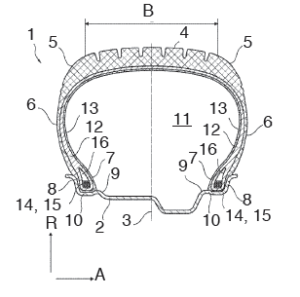
Key statement: An article is a non- pneumatic tire for a motor vehicle and the article’s use is that is suitable as at least a part of a pressurizable container or pipeline. The article includes a first side that is, in use, configured to be exposed to a first environment and a second side that is, in use, configured to be exposed to a second environment. At least a part of the article includes rubber based material that is configured to restrict fluid permeability and that includes lignin that has been treated by hydrothermal carbonization. The rubber based material or a coating of the rubber based material forms at least a part of the first side and the first side is, in use, configured to be exposed to a higher pressure than the second side. A method is for manufacturing the article.
Rubber-metal laminate and gasket
U.S. patent: 12,692,942
Issued: July 28, 2026
Inventors: Isao Watanabe, Ryota Shimura and Daiki Takekawa
Assigned: Nok
Key statement: A rubber-metal laminate that includes a metal member; and a rubber layer provided on the metal member, wherein the rubber layer has a 100% modulus value in accordance with JIS K6251 of 6.0 MPa or more and a thickness of less than 80 μm. The gasket includes the rubber-metal laminate.
Sulfur crosslinkable rubber composition comprising a graft copolymer
U.S. patent: 12,692,362
Issued: July 28, 2026
Inventors: Catarina Sà and Carla Recker
Assigned: Continental Reifen Deutschland
Key statement: The present invention relates to a sulfur crosslinkable rubber composition comprising a filler component in an amount in the range of 1 to 350 phr and at least one graft copolymer having a modified diene rubber backbone and one or more oligomeric side chains grafted to the modified diene rubber backbone, wherein the oligomeric side chains are obtained through reversible addition fragmentation chain transfer polymerization of a monomer composition and wherein the monomer composition comprises at least one polar monomer.
Method for modifying expandable curing membranes for manufacturing tires
U.S. patent: 12,692,355
Issued: July 28, 2026
Inventors: Milan Fedurco, Marco Ribezzo, Antonio Delfino and Alain Faugeras
Assigned: Michelin
Key statement: A process for modifying an expandable curing bladder for a tire, which bladder has a surface intended to come into contact with a tire casing is provided. The process comprises a step of applying to the surface a layer of a silicone rubber composition comprising a first liquid organopolysiloxane bearing chain-end alkenyl groups, a second liquid organohydropolysiloxane and a photoactivatable hydrosilylation catalyst and a step of exposing the silicone rubber composition covering the surface to irradiation with ultraviolet visible light.
VOC free coupling agents for rubber compositions
U.S. patent: 12,698,377
Issued: August 4, 2026
Inventors: Yuan-Yong Yan and Gyusaang Youn
Assigned: Goodyear Tire & Rubber
Key statement: A coupling agent, a rubber composition and a shaped article formed from the rubber composition, such as a pneumatic tire, are described. The coupling agent is represented by Formula I and is capable of linking a substrate, such as a mineral oxide, carbon black or brass, to an unsaturated elastomer:
Formula 1
FG1 — LG1 — Sa — LG2 — FG2
where FG1 and FG2 each represent a functionalized arylene group, which can be the same or different; LG1 and LG2 each represent a linking group, which can be the same or different; and Sa represents a sequence of two or more connected sulfur atoms, where a is a number which is at least 2.
Rubber composition for a winter tire and a winter tire
U.S. patent: 12,698,380
Issued: August 4, 2026
Inventors: Luisa Fernanda Munoz Mejia, Claude Charles Jacoby, Karmena Izabela Anyfantaki, Evangelia Konstantaki and Veronique Marie-Josee Herbeuval
Assigned: Goodyear Tire & Rubber
Key statement: The present invention is directed to a rubber composition comprising 35 phr to 60 phr of a first polybutadiene rubber having a glass transition temperature within a range of -80°C to -105°C, 5 phr to 30 phr of a second polybutadiene rubber having a glass transition temperature within a range of -20°C to -40°C, 10 phr to 60 phr of polyisoprene selected from one or more of synthetic polyisoprene and natural rubber, 30 phr to 200 phr of at least one filler and 40 phr to 120 phr of at least one plasticizer having a glass transition temperature within a range of -40°C to -110°C. Furthermore, the present invention is directed to a tire comprising the rubber composition.
Method for producing a rubber composition comprising a rubber crumb
U.S. patent: 12,698,379
Issued: August 4, 2026
Inventors: Etienne Fleury and Mathilde Lacoste
Assigned: Michelin
Key statement: A process for preparing a rubber composition based on at least one diene elastomer, a reinforcing filler, a crumb rubber and a crosslinking system is provided. The process comprises at least the following steps: incorporating the reinforcing filler into the diene elastomer, all at once or in several stages, and mixing; when the temperature of the mixture reaches a temperature of greater than 100°C, adding the crumb rubber; continuing the mixing up to a maximum temperature of between 120°C and 190°C; cooling the mixture to a temperature of less than 100°C; incorporating the crosslinking system and mixing up to a maximum temperature of less than 110°C.
Rubber composition
U.S. patent: 12,698,382
Issued: August 4, 2026
Inventors: Tenko Hayashi and Christine Nourry
Assigned: Michelin
Key statement: A rubber composition is based on at least an elastomer matrix comprising at least one first diene elastomer bearing at least one SiOR1 function, R1 being a hydrogen atom or a hydrocarbon radical, the SiOR1 function not located at the chain ends of the first diene elastomer, a reinforcing filler comprising a reinforcing inorganic filler and a plasticizing agent comprising a liquid plasticizer comprising a liquid diene polymer bearing at least one function.
Tire traction with a brake system for frozen and wet pavement
U.S. patent: 12,697,945
Issued: August 4, 2026
Inventors: Abdiel Ramirez, Lidia Palacios-Ramirez and Valentina Rose Ramirez
Key statement: A tire traction with a brake system for frozen and wet pavement including an anti-slip assembly, a tire traction assembly and an electronic assembly. Anti-slip assembly includes linear motion mechanisms coupled near to the vehicle’s wheels, the mechanisms when deployed abuts against the frozen pavement, preventing the vehicle from slipping in an inclined street during black ice. Tire traction assembly includes a deployable mechanism with a set of wheels covered by a set of crawler belts, wherein traction peaks attached across the set of crawler belts allows the vehicle to improve traction when driving over frozen pavement. Electronic assembly includes a plurality of sensors that allow the anti-slip assembly and the tire traction assembly to be deployed and undeployed automatically. An alarm is actuated to notify the user when a sensor has detected and activated one or both assemblies.
Method for preparing rubber for elastomer of flexible joint
U.S. patent: 12,709,677
Issued: August 18, 2026
Inventors: JianboJi, Changqing Ye, Jing Feng, Yanan Hou, Bo Sun, Gui Zhang and Rui Liu
Assigned: Xi’an Sunward Aeromat
Key statement: A method for preparing a rubber for an elastomer of a flexible joint, includes: weighing hydrogenated nitrile raw rubber, a silica reinforcing agent, aramid fiber pulp, carbon black, liquid nitrile rubber, zinc oxide, stearic acid, an antioxidant and a peroxide crosslinking agent; plasticating the hydrogenated nitrile raw rubber in a first internal mixer at 125-135°C, collecting a resulting product and cooling to yield a plasticized rubber; preheating the liquid nitrile rubber; adding the plasticized rubber to a second internal mixer, further adding the aramid fiber pulp, the zinc oxide, the stearic acid and the antioxidant to the second internal mixer for first mixing; adding the carbon black to the second internal mixer for second mixing; adding the silica reinforcing agent and the preheated liquid nitrile rubber to the second internal mixer for third mixing; and collecting a discharged product when a temperature of the second internal mixer is 140°C.
Programmable elastomer robot system and methods
U.S. patent: 12,703,117
Issued: August 11, 2026
Inventors: Farshid Alambeigi and Uksang Yoo
Assigned: Board of Regents, The University of Texas System
Key statement: An elastomer robot comprises a flexible internal structure comprising a first flexible material, wherein the internal structure is tunable, and a flexible external structure comprising a second flexible material, attached to the internal structure, including an aperture configured to accept a fluid, wherein the external structure is tunable. Methods of use and production are also disclosed.
System and process for manufacturing laser marked elastomer components
U.S. patent: 12,709,046
Issued: August 18, 2026
Inventors: Silji Abraham, David Martin and Jason Krizan
Assigned: West Pharmaceutical Services
Key statement: A system for manufacturing elastomeric components is provided. The system may include a molding station having a mold configured to receive an elastomeric material, form a pad that includes a plurality of untrimmed elastomeric components and cure the pad. The system may further include an automated marking station comprising a laser and a camera. The automated marking station may be configured to remove the cured pad from the molding station, present the cured pad to the laser to form a mark on each of the untrimmed elastomeric components and present the cured pad to the camera to capture an image of each mark. A process for manufacturing the elastomeric components is also provided.
High strength hydrogenated polymers and rubber compositions incorporating same
U.S. patent: 12,715,952
Issued: August 25, 2026
Inventors: Noriaki Yukimura, Michael R. Beaulieu, Zengquan Qin, Jeffrey M. Magistrelli, Walter A. Salamant, Ryan J. Hue, Shu Wang and Laura S. Kocsis
Assigned: Bridgestone
Key statement: Embodiments of the present disclosure are directed to functionalized copolymers produced by copolymerization of at least one conjugated diolefin monomer and at least one vinyl monomer, the functionalized copolymer including at least one functional group having silica reactive moieties, wherein the functionalized copolymer has a degree of hydrogenation of 75% to 98 mol % as measured using proton nuclear magnetic resonance spectroscopy (1H NMR). In one or more embodiments, the silane modifier may include an oxygen containing moiety, wherein the oxygen atom of the oxygen containing moiety may not be directly bonded with the silicon atom.