
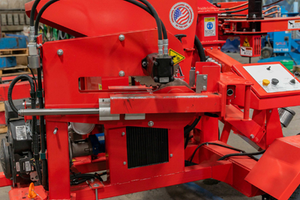
Removing the bead before shredding offers tire recyclers another option
Milwaukee, WI – For tire recyclers, truck service centers, tire stores and other businesses that regularly accumulate scrap tires, there are two conventional options: Pay someone to haul the tires away for recycling or invest in equipment to process them in-house.
But there is considerable middle ground between those approaches.
A large tire recycler may generate enough volume to justify investing in a high-torque industrial shredder. A truck repair facility or tire store paying thousands of dollars each month to dispose of scrap tires may not. Even recyclers with small or midsize shredders can encounter challenges when processing larger truck and off-the-road tires.
Off-the-road, or OTR, tires are the large, heavy tires used on construction, mining, earthmoving and agricultural equipment. Sizes vary widely, but the recycling challenge becomes apparent when one of these tires reaches a shredder. There is substantially more material to process, and some internal reinforcing components are particularly heavy-duty.
One of those components is the bead wire. The bead is the reinforced ring around the tire’s inner diameter that secures it to the wheel rim. Embedded in the rubber are bundles of high-strength steel wire. During normal operation, the steel helps keep the tire securely seated on the rim. At the end of the tire’s useful life, however, that same steel presents a challenge for recyclers.
Repeatedly cutting through bead wire with a shredder can put unnecessary demands on the equipment.
A common assumption when processing larger tires is that the solution is a bigger shredder with a larger cutting chamber, more horsepower and greater torque. Although that approach can work, feeding an entire tire into a shredder means the machine must process every component, including the bead.
In larger truck and OTR tires, the bead can contain a substantial concentration of high-tensile steel, with wire bundles approximately 5/8 to 3/4 inch thick.
“The issue is not whether a sufficiently large shredder can cut it — it can. The question is whether it makes economic sense to repeatedly force shredder knives through that material when the bead can be removed first,” said John Neuens of BCA Industries, a Wisconsin-based manufacturer of industrial shredding and recycling equipment.
That is the premise behind BCA Industries’ SWC100 Sidewall Remover. The machine cuts both sidewalls, including the bead area, from the tire before the remaining tread reaches the shredder. A newly introduced tread cutter attachment allows operators to cut the remaining tread into smaller sections for shredding, transportation or disposal.
The SWC100 is an all-hydraulic machine equipped with an automatic tire lift. Rather than manually positioning a large tire, the operator uses the lift to raise it into the machine, where both sidewalls are cut during the same loading cycle. This eliminates the need to cut one sidewall, flip the tire and cut the other.
BCA offers the SWC100 in portable, gas-powered and stationary, electric models. The tread cutter bolts directly onto either version and connects to the machine’s existing hydraulic and control systems. Customers can order the attachment with a new machine or add it to existing equipment.
BCA estimates that the SWC100 can process approximately one tire every 35 seconds. It can handle tires ranging from passenger tires as small as 17 inches to semi-truck tires up to 44 inches.
After the sidewalls are removed, the operator moves the remaining tread to the cutter. The attachment mounts to the existing SWC100 frame and uses the machine’s hydraulic and control systems. It features a specialized saw-type cutting system, and both sets of cutting components can be sharpened while installed on the machine.
The cutter requires two-hand operation, meaning it runs only when both of the operator’s hands are in the required push position.
For material being transported elsewhere for final processing, a single cut opens the tread ring so it can lie flatter and stack more efficiently. Operators can make additional cuts to reduce the tread to the desired size.
Removing the sidewalls before shredding offers another potential benefit: The material does not necessarily have to be discarded. Intact tire sidewalls have established reuse markets because they are heavy, durable and useful in applications requiring weight.
One example is the base of traffic barrels. In agriculture, sidewalls can be placed over plastic covering outdoor silage piles to hold the material in place.
“It’s not really tire recycling, it’s tire reuse, but it’s pretty universal,” Neuens said.
According to Neuens, sidewalls can sell for approximately $2 each. At a processing rate of 100 tires per hour, with two potentially saleable sidewalls recovered from each tire, the material could generate approximately $400 per hour in gross revenue.
“At that rate, the economics start to become fairly straightforward when compared to the approximate cost of the equipment,” Neuens said. “It’s a pretty quick payback.”
Actual returns will depend on processing volume, labor, operating costs and the availability of buyers for the recovered material.
For tire recyclers, the value of combining a sidewall remover and tread cutter lies in changing the material that enters the shredder. Instead of feeding an entire truck or OTR tire into the machine, operators can first remove the sidewalls and heavily reinforced bead, then cut the remaining tread into smaller sections.
For recyclers operating small or midsize shredders, that preprocessing can make a difference. The shredder still performs the primary size-reduction work, but it receives material that has had one of its more difficult components removed and has been reduced to a more manageable size.
The sidewall remover and tread cutter can serve as the first steps in a processing line, followed by shredding and additional material handling as needed.
BCA’s PD1000 and PD1000 IO offer options for subsequent processing. The PD1000 is a portable, dual-shaft, low-speed, high-torque shredder designed to process semi-truck tread after the sidewalls are removed. The PD1000 IO adds material handling to the process.
For operations processing passenger tires, semi-truck tires and super-single tires, the PD2000 provides another option, processing whole tires into tire-derived fuel, or TDF.
An option for tire stores and truck service centers
Truck service centers and tire stores that generate large volumes of scrap tires but do not have enough material to justify buying a shredder may also benefit from the equipment.
According to Neuens, some truck repair facilities pay an average of $15 to $20 to have each truck tire removed. By combining the sidewall remover and tread cutter, an operation can remove both sidewalls, potentially sell them, and cut the remaining tread into manageable sections for consolidation, transportation or disposal.
Storage is another consideration. Tire stores and truck service centers continually generate scrap tires, and the tires accumulate between pickups. Intact tires also take up considerable space.
Removing the sidewalls and cutting the remaining tread as tires accumulate can change that equation. The material becomes easier to store, handle and transport, giving businesses another option beyond waiting for the next pickup.
Not every operation needs the same level of processing. Some may want to prepare tires for an existing shredder, while others may simply need to reduce their size to make storage, handling and transportation more manageable.
The tread cutter gives operators another way to handle scrap tires based on what they plan to do with the material next.