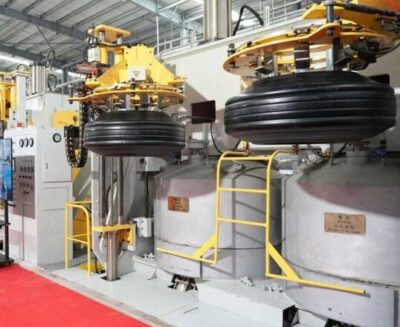
Shaping the future of rubber product manufacturing with smart automation
by Soren Blomaard and Ly Ho, Taniq. Automation developments and how they can be applied for the automated design and
Read More
by Soren Blomaard and Ly Ho, Taniq. Automation developments and how they can be applied for the automated design and
Read MoreA classified list of rubber machinery and equipment with supplier companies is followed by directories of the companies that supply
Read MorePatents as compiled by the editors of Rubber World Magazine for July 2025. Silicone rubber composition U.S. patent: 12,162,986 Issued: December 10,
Read MoreKraussMaffei Extrusion now offers machine technology with the flexible ZE BluePower, which processes formulations with halogen-free flame retardants in polyolefins – as an alternative to conventional cable formulations based on halogenated flame retardants. The specially configured extruder is used to produce high-quality HFFR (Halogen Free Flame Retardant) compounds with ATH (Aluminum Trihydroxide) content of up to 65%. Additionally, the ZE BluePower can be adapted to various process tasks and formulations, offering customers high flexibility for individual requirements.
Read MoreWevo has unveiled three new silicone-based potting compounds designed to meet the growing demands of modern electronic components. The WEVOSIL 22106 FL, 22102 FL, and 22105 FL compounds offer a unique combination of supersoft consistency, thermal conductivity, and mechanical resilience, making them ideal for sensitive and thermally demanding applications.
Read MoreRubber and elastomer materials play a crucial role throughout the medical landscape, delivering critical functionality in a countless range of
Read MoreThe United Nations Sustainable Development Goals (UNSDGs) aim to provide clean drinking water to all individuals by 2030, including those
Read MoreSilicone rubber, also known as polysiloxane, is a synthetic polymer composed of a siloxane (–Si–O–) backbone with additional organic groups,
Read MoreThe healthcare industry continuously demands more effective and patient-friendly treatment solutions, and implantable drug delivery devices are one of the
Read MoreTrueSilX50, the first in a series of silicone materials, brings the durability and flexibility expected of molded silicone into a scalable, production-ready 3D printing process. With a 48A Shore Durometer, 330% Elongation at Break, and 22N/m tear strength, it meets the mechanical demands of medical, industrial, and wearable applications. Biocompatibility testing is currently in progress, and Axtra3D anticipates that this material will pass key biocompatibility tests, including Cytotoxicity, Skin Irritation, and Skin Sensitization, like the previous TrueSil Silicones from Spectroplast. Unlike extruded silicone, which struggles with layering artifacts and surface roughness, TrueSilX50 provides an ultra-smooth, precise, isotropic finish, eliminating inconsistencies and delivering exceptional feature detail, even in complex geometries.
Read More