
April Patents
Patents as compiled by the editors of Rubber World from the USPTO office.
1-amino-3-(oxyalkylalkoxysilyl)-2-propanol-terminated diene rubbers
U.S. patent: 12,371,514
Issued: July 29, 2025
Inventor: Norbert Steinhauser
Assigned: Arlanxeo
Key statement: The invention concerns 1-amino-3-(oxyalkylalkoxysilyl)-2-propanol-terminated diene rubbers, their preparation and use.
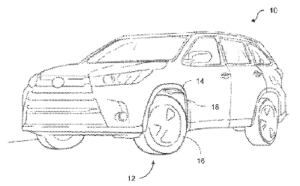
Vehicular sensing system with tire profile determination
U.S. patent: 12,391,073
Issued: August 19, 2025
Inventor: Reinhard Juette
Assigned: Magna Electronics
Key statement: A vehicular driving assist system includes a sensor disposed at a vehicle and operable to capture sensor data. An electronic control unit (ECU) includes electronic circuitry and associated software and the electronic circuitry includes a data processor for processing sensor data captured by the sensor. The vehicular driving assist system, via processing at the data processor of sensor data captured by the sensor, detects a tread of a tire of the vehicle. The vehicular driving assist system determines a tread depth of the tread of the tire. The vehicular driving assist system, responsive to the determined tread depth being below a threshold tread depth, generates a worn tire signal to alert a driver of the vehicle that the determined tread depth is below the threshold tread depth.
Method for producing polyisoprenoid, vector, transformed plant, method for producing pneumatic tire and method for producing rubber product
U.S. patent: 12,391,964
Issued: August 19, 2025
Inventors: Haruhiko Yamaguchi, Yukino Inoue, Kazuhisa Fushihara, Seiji Takahashi, Toru Nakayama and Satoshi Yamashita
Assigned: Sumitomo Rubber Industries
Key statement: Provided is a method for producing a polyisoprenoid, which makes it possible to synthesize in vitro a polyisoprenoid having an unprecedented structure, such as a 100% cis-polyisoprenoid or a polyisoprenoid containing an allylic diphosphate derivative as an initiating terminal. Also provided is a method for producing a polyisoprenoid in vitro, which employs a gene coding for a neryl diphosphate synthase and rubber particles bound to a protein encoded by the gene, or a method for producing a polyisoprenoid, which includes introducing into a plant a vector in which a gene coding for a neryl diphosphate synthase is linked to a promoter having a promoter activity that drives laticifer-specific gene expression to express a protein encoded by the gene specifically in laticifers.
Method for preparing a recycled rubber based elastomer
U.S. patent: 12,391,816
Issued: August 19, 2025
Inventors: William B. Coe
Key statement: Crumb rubber obtained from recycled tires is subjected to a process involving phase reticulation induced sulfidic metathesis. The process utilizes a reactive component that interferes with sulfur bonds, assisted by exposure to a pulsed magnetic field. The resulting rubber, subjected to interlinked substitution, exhibits properties similar to those of the virgin composite rubber structure prior to being granulated, or other polymeric materials and is suitable for use in fabricating new tires, engineered rubber articles, and asphalt rubber for use in waterproofing and paving applications.
Tire
U.S. patent: 12,391,818
Issued: August 19, 2025
Inventor: Saki Okudaira
Assigned: Sumitomo Rubber Industries
Key statement: The present disclosure provides a tire which makes it possible to reduce the increase in hardness and the decrease in wet grip performance from before to after heat aging. The present disclosure relates to a tire including a tread, the tread including an elastomer composition containing a styrene elastomer and urethane particles, the tread satisfying the following relationship (1): (M100a−M100f)/M100f×100 ≤ 38 wherein M100f represents the stress at 100% elongation (23°C) before heat aging and M100a represents the stress at 100% elongation (23°C) after heat aging.
Fluorinated copolymer composition and crosslinked rubber article
U.S. patent: 12,391,782
Issued: August 19, 2025
Inventor: Tsuyoshi Kawai
Assigned: AGC
Key statement: To provide a fluorinated copolymer composition whereby a crosslinked rubber article having a low compression set at high temperature can be formed, and a crosslinked rubber article. The fluorinated copolymer composition of the present invention comprises a fluorinated copolymer, an organic peroxide, a compound having at least two polymerizable unsaturated bonds and a phosphorus compound having a melting point of 60°C or lower.
Rubber composition for tire tread
U.S. patent: 12,391,822
Issued: August 19, 2025
Inventors: Vikram Singh, Louis Reuvekamp, Tharik Mohamed and Hendrik Stevens
Assigned: Apollo Tyres Global R&D
Key statement: The present invention relates to a crosslinkable rubber composition, the crosslinkable rubber composition comprising, based upon parts by weight per 100 parts by weight rubber (phr): ≥60 phr to ≤80 phr of a butadiene rubber, a syndiotactic 1,2-polybutadiene, coupling agent, a filler and a resin, wherein the composition comprises ≥10 phr to ≤20 phr of the syndiotactic 1,2-polybutadiene, and wherein the composition comprises ≥1 phr to ≤20 phr of at least two coupling agents wherein one of the coupling agents is or comprises a mercapto based silane and wherein the ratio of the mercapto based silane to the second coupling agent is in the range of ≥2:1 to ≤:10:1.
Rotary feed-through, in particular for regulating tire pressure
U.S. patent: 12,391,075
Issued: August 19, 2025
Inventors: Andrea Evangelisti and Enrico Pieralice
Assigned: Trellborg Wheel Systems
Key statement: A rotary feed-through, designed to transfer a fluid between two entities in rotary motion with respect to one another. The rotary feed-through includes an inner cylindrical ring and an outer cylindrical ring, which are free to turn with respect to one another and provided with channels for passage of the fluid. The channels are connected via at least one annular space axially delimited by seal rings housed in a cylindrical seat. The cylindrical seat faces radially outwards or inwards and is axially delimited, on one side, by an axial abutment of the inner and outer cylindrical rings and, on the other side, by an axial abutment of a lid, a closing ring, or an intermediate ring. The seal rings are interference fitted to the inner or outer cylindrical ring and provided with an elastic portion for contact with the surface of the inner or outer cylindrical ring.
Functionalized carbon black, preparation thereof and use in vulcanizable rubber compositions
U.S. patent: 12,391,817
Issued: August 19, 2025
Inventors: Hauke Westenberg, Conny Vogler, Werner Niedermeier, Dirk Rechenbach and Arndt-Peter Schinkel
Assigned: Orion Engineered Carbons
Key statement: The present disclosure provides a functionalized carbon black obtained by treating an oxidized carbon black with a sulfur-containing primary or secondary amine or a salt thereof. The disclosure also relates to a process for preparing such functionalized carbon black. Furthermore, the present disclosure relates a vulcanizable rubber composition including (i) a vulcanizable rubber component, and (ii) an oxidized carbon black and (iii) a sulfur containing primary or secondary amine or a salt thereof, or a functionalized carbon black formed from these components. The disclosure also concerns an article made from the vulcanizable rubber composition. The functionalized carbon blacks disclosed herein are particularly useful for obtaining rubber compounds with low hysteresis and enhanced abrasion resistance, e.g., for the production of energy-saving tires.
Non-inflatable hollow tire mold
U.S. patent: 12,390,972
Issued: August 19, 2025
Inventors: Mingjiang Wang, Li Liu, Shipeng Wen and Feng Wang
Assigned: Jiangsu Risingsun Tyre
Key statement: An inflation-free hollow tire modeling die comprises a die base, at least one die core and a core holder. A front face of the die base has a concave feeding cavity and a bottom of the feeding cavity has a modeling cavity running through a back face of the die base. The core holder has an arched or triangular support. Feet of the support are fixed to an outer edge portion of the feeding cavity. A top of the support is located in front of the modeling cavity. The die cores are suspended and their main bodies are columnar. The length direction of the die cores is perpendicular to the front and back faces of the die base. A head end of each die core is fixedly connected to the core holder. A tail end of each die core is extended backward and positioned in the modeling cavity.
Tread rubber composition with majority renewable content
U.S. patent: 12,397,585
Issued: August 26, 2025
Inventors: Stacey Lynne Dean-Sioss and Alexis Anne Kruth
Assigned: Goodyear Tire & Rubber
Key statement: A tire component formed from a rubber composition comprises a majority weight percent of renewable materials. The rubber composition comprises, based on 100 parts per weight (phr) of elastomer: a blend of at least two rubber elastomers selected from a group consisting of: from about 15 phr to about 50 phr polybutadiene; up to about 20 phr of styrene-butadiene copolymer; up to about 90 phr of natural rubber; a bio-derived resin material; a vegetable triglyceride oil; and a bio-derived filler comprising silica and carbon black filler. The carbon black filler is at least partially derived from a bio-based feedstock prior to its addition to the rubber composition. The resin and the silica are also derived from renewable materials. In some embodiments, the contemplated polybutadiene may be from mass balanced feedstocks.
Modified conjugated diene based polymer, method for preparing the same and rubber composition including the same
U.S. patent: 12,398,231
Issued: August 26, 2025
Inventors: Jung Hwan Oh, Ho Young Lee and Jae Sun Choi
Assigned: LG Chem
Key statement: The present invention relates to a modified conjugated diene based polymer having excellent rolling resistance and improved processability, a method for preparing the same and a rubber composition including the same and provides a modified conjugated diene based polymer which includes a repeating unit derived from a conjugated diene based monomer and a functional group derived from a modifier and satisfies conditions (i) to (vii), a method for preparing the same and a rubber composition including the same.
Rubber composition and pneumatic tire
U.S. patent: 12,398,217
Issued: August 26, 2025
Inventors: Rie Yasuda and Ryoji Matsui
Assigned: Sumitomo Rubber Industries
Key statement: Provided are a rubber composition which provides a self-healing rubber with improved strength and wet grip performance and a pneumatic tire including the rubber composition. The present disclosure relates to a rubber composition containing a rubber component having a functional group containing a cationic functional group and/or an anionic functional group, a filler capable of generating a charge paired with the functional group and sulfur.