Trends shaping the future of tire manufacturing
As the tire industry faces shifting consumer expectations, the rise of EVs and rapid technological change, what will the tire
Read More
As the tire industry faces shifting consumer expectations, the rise of EVs and rapid technological change, what will the tire
Read MoreThere are many tools to facilitate sustainability in tire manufacturing, including automation and robotics, operations modeling and simulations, and new material technology concepts.
Read MoreDevulcanization methods such as chemical, mechanical, irradiation, biological and combinations are reviewed, and additional steps are presented to turn post-consumer goods, like end-of-life tires, into engineering materials and products.
Read MoreFarm tire innovations through the decades are presented, including the switch from steel to rubber tires, tread designs and materials within the tires.
Read Moreby Vishal K. Chaurasia, David Maroli and Steve Trapp, Finite Fiber. Short fiber reinforcement has been used in elastomeric and
Read Moreby Patrick Buder, Zeppelin Systems GmbH, and Sara Liébana Viñas, Evonik Industries AG. A liquid dosing system allows specialized high-performance
Read MoreUnlike traditional automation that relies on predefined instructions, AI-driven systems learn, adapt and make real-time decisions through machine learning and data analysis. This shift enables businesses to handle complex, dynamic environments with greater flexibility and precision, continually improving and optimizing based on real-world conditions. AI-powered automation predicts needs, identifies inefficiencies and evolves with each interaction, facilitating faster and smarter decision-making, without human intervention.
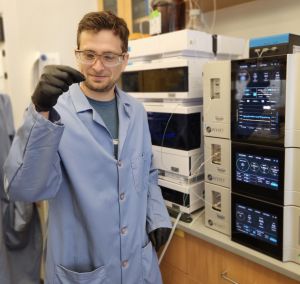
Read MoreThe University of North Carolina at Chapel Hill researchers introduce a sulfur diimide reagent that enables the installation of amine groups at specific locations in the polymer chains. This step is crucial because it sets the stage for the subsequent backbone rearrangement. This chemical reaction reorganizes the polymer backbone, breaking down the rubber into soluble amine-functionalized materials that can be used to produce epoxy resins.
The researchers showed that their two-step process works very well. In a test with a model polymer, they broke it down significantly, reducing its molecular weight from 58,100 g/mol to about 400 g/mol. When they applied the method to used rubber, it broke down completely in just six hours, turning it into a soluble material with amine groups that could be used to manufacture broadly useful materials like epoxy resins.
Read MorePerformance properties of a surface treated low hysteresis carbon black (Continext-LH) compound in a natural rubber tread formulation are compared with those of a conventional N234 low hysteresis version and show that the new material had significantly improved rolling resistance and directional improvement in damage resistance without negative effects or trade-offs in wet traction and wear resistance.
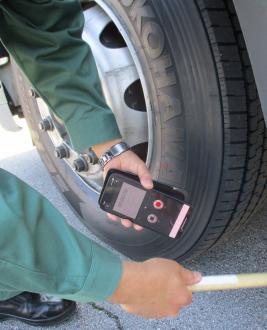
Read MoreThe Yokohama Rubber Co., Ltd., has begun practical testing of a technology that uses artificial intelligence (AI) to gauge air pressure from the sound made by tapping truck and bus tires. Using AI to gauge tire air pressure from the sound made by tapping the tire, which previously relied on the driver’s experience, will provide logistics companies with solutions to various issues, including safe vehicle operation via improved air-pressure measurement, cost reductions and greater operational efficiency through labor-saving, and raising fuel efficiency by appropriately managing tire air pressure.
Read More