
Mitsubishi Chemical develops new negative thermal expansion filler
Tokyo, Japan – Mitsubishi Chemical Corporation has decided to commercialize a new negative thermal expansion filler (contracts when heated) developed for semiconductor packaging materials. We will begin selling pilot products by the end of FY2026, proceed with customer evaluations and certifications, and launch sales of mass produced products in the second half of FY2027.
The newly commercialized negative thermal expansion filler will be marketed under the brand name “M-Filleris™ NTE.” Going forward, we plan to add other functional fillers with performance features such as heat dissipation and electrical properties to the lineup as the “M-Filleris™” series.
In recent years, with the spread of AI servers and high-performance computing (HPC), demand for even more powerful semiconductors is growing. Semiconductor packages are increasingly adopting advanced packaging technologies such as chiplet technology and 3D stacking technology, and increased heat generation due to high-density chip packaging has become an issue.
Currently, epoxy resins and silica fillers are the primary materials used in semiconductor packaging and high filler content is increasingly being used to suppress warpage caused by thermal expansion. However, in recent years, filler content has been approaching its limit, so in order to further reduce thermal expansion, we developed a negative thermal expansion filler that contracts when heated.
This product was developed using the inorganic material design technology that we have cultivated over many years. It overcomes problems found in conventional negative thermal expansion materials—such as narrow operating temperature range, non-spherical shape, high specific gravity, and high water absorption—thus enabling its application in semiconductor packaging. Its main features include:
Significantly reduces thermal expansion when compounded in epoxy resins, etc.
Negative thermal expansion characteristics over a wide temperature range from room temperature to 400°C
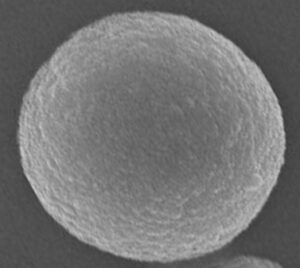
Excellent fluidity and dispersibility due to its spherical shape
Low alpha particle emission through impurity control (reduction of soft errors)
Specific gravity and low water absorption comparable to general semiconductor fillers (silica fillers)
Applications to semiconductor encapsulants, underfill materials, build-up film materials, etc.
Furthermore, by leveraging synergies with our existing epoxy resin business, we plan to not only offer fillers individually, but also in masterbatches mixed with epoxy resin, etc. This will also help shorten our customers’ material design and development timelines.
Through this product, we will provide new solutions in the semiconductor materials market—which is expected to grow as demand for AI and data centers expands—and contribute to the sustainable development of society.