
U.S. non-automotive rubber transmission belts market set to reach $1.85 billion by 2032
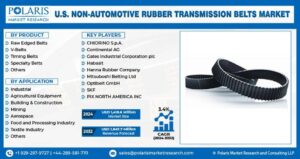
Dover, DE – The U.S. non-automotive rubber transmission belts market is on a steady growth trajectory, projected to reach a valuation of USD 1.85 billion by 2032, according to a recent report by Polaris Market Research. This expansion reflects a compound annual growth rate (CAGR) of 3.4% from 2024 to 2032.
Driven by a diverse industrial landscape and ongoing infrastructure development, the demand for rubber transmission belts remains robust across sectors such as aerospace, food processing, agriculture, and manufacturing. These belts play a critical role in machinery and equipment operations, offering durability and efficiency in harsh working environments.
Technological innovation is a key factor fueling market growth. Advancements in belt materials—such as synthetic rubbers, fiber-reinforced composites, and polymer blends—have led to products with enhanced flexibility, heat resistance, and wear durability. These improvements are helping industries reduce maintenance costs and improve operational efficiency.
Among product types, v-belts are expected to see significant growth due to their versatility and cost-effectiveness across multiple applications. In 2023, the industrial segment dominated the market, underscoring the reliance of U.S. industries on transmission belt-powered machinery.
Despite the positive outlook, the market faces challenges from fluctuating raw material prices, particularly for natural rubber and synthetic elastomers. These price instabilities impact production costs and profit margins, posing difficulties for manufacturers in maintaining competitive pricing strategies.
Major players in the U.S. market include CHIORINO S.p.A., Continental AG, Gates Industrial Corporation plc, Habasit, Hanna Rubber Company, Mitsuboshi Belting Ltd, Optibelt GmbH, PIX NORTH AMERICA INC, and SKF. These companies are actively investing in product innovation and expanding their market presence to meet evolving industry demands.
As industries continue to prioritize energy efficiency and sustainability, the U.S. non-automotive rubber transmission belts market is expected to remain a vital component of the country’s industrial backbone.