
Patents for July
Deproteinized natural rubber latex and preparation method
U.S. patent: 12,565,576
Issued: March 3, 2026
Inventors: Xiaohui Tian, Dongqi Wang, Xinyue Wang, Huijun Zhang and Yaqin Zhou
Assigned: Hunan Vontex New Material Technology
Key statement: A deproteinized natural rubber latex and preparation method thereof are provided. A combined immobilization technology of a multi-enzyme system is introduced to form a multi-enzyme synergistic effect, such that high concentration enzymes contact with proteins in natural rubber latex. Meanwhile, due to the complexity and diversity of latex proteins, the catalytic properties of different enzymes are effectively combined to realize a multi-enzyme cascade reaction and the proteins are hydrolyzed gradually and orderly. In addition, an immobilized enzyme filter screen is introduced and the filter screen is lifted and circulated to make rubber particles collide with high density enzyme carrier and then complete mixing evenly to reduce damages to the rubber particles when surface proteins are removed, thereby maintaining original physical properties of the latex. The rubber latex has high stability, reusability, is easy for separation and continuous operation and is environmentally friendly.
Self sealing tire
U.S. patent: 12,521,952
Issued: January 13, 2026
Inventors: Michael Lawrence Gersman, George Jim Papakonstantopoulos and Andreas Frantzen
Assigned: Goodyear Tire & Rubber
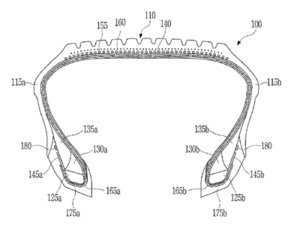
Key statement: This invention reveals an uncured pneumatic tire which is comprised of a generally toroidal shaped supporting carcass with an outer circumferential tread, two spaced beads, at least one ply extending from bead to bead, sidewalls extending radially from and connecting the tread to the beads, a sealant layer which is disposed inwardly from the supporting carcass and an innerliner which is disposed inwardly from the sealant layer, wherein circumferential tread is adapted to be ground contacting and wherein the sealant layer is comprised of polyisobutylene or a butyl rubber, wherein the polyisobutylene or the butyl rubber has a number average molecular weight which is within the range of 30,000 to 100,000.
Silane functional amine compositions and their use in rubber
U.S. patent: 12,570,833
Issued: March 10, 2026
Inventors: Matthew J. Pinnow, Adeyemi A. Adepetun, Richard W. Cruse, Lesley Hwang, Nancy Winchester, Linda Vecere and Yanjun Zhu
Assigned: Momentive Performance Materials
Key statement: The present disclosures are directed to a composition comprising at least one silane functional amine; a method of preparing a silane functional amine; a rubber composition comprising at least one silane functional amine, at least one diene based polymer, silica, at least one process aid and a vulcanizing package comprising at least one vulcanizing agent comprising sulfur and at least one accelerator; and a process of preparing a rubber composition.
Thermoplastic elastomer composition and shaped article thereof
U.S. patent: 12,570,842
Issued: March 10, 2026
Inventors: Nana Tatematsu and Hayato Kurita
Assigned: Mitsui Chemicals
Key statement: One embodiment of the present invention relates to a thermoplastic elastomer composition or a shaped article thereof. The thermoplastic elastomer composition is a composition including 100 parts by mass of an ethylene/α-olefin/non-conjugated polyene copolymer (A); 20 to 80 parts by mass of a propylene polymer (B) having a melt flow rate (measured at 230°C under 2.16 kg load in accordance with ASTM D 1238-65T) of 1 to 100 g/10 minutes; and 0.1 to 50 parts by mass of an inorganic filler (C); or is a composition obtained by dynamically crosslinking 100 parts by mass of an ethylene/α-olefin/non-conjugated polyene copolymer (A); 20 to 80 parts by mass of the propylene polymer (B); 0.1 to 50 parts by mass of an inorganic filler (C); and a crosslinking agent (D).
Rubber composition for tires
U.S. patent: 12,577,378
Issued: March 17, 2026
Inventors: Anup Mondal and Mohamed Tharik
Assigned: Apollo Tyres Global
Key statement: A crosslinkable rubber composition may include, per hundred parts by weight of rubber (phr): 100 phr of a blend of a natural rubber (NR), a polybutadiene rubber (BR) and first and second solution polymerized styrene butadiene rubbers (SSBR); a silica filler, a resin and ≥1 phr to ≤20 phr of first and second coupling agents, wherein the first coupling agent is a mercaptosilane and the second coupling agent is selected from a disulfide silane, a tetrasulfide silane or a combination thereof.
Olefin based thermoplastic elastomer foamed particle and olefin based thermoplastic elastomer foamed particle molded body
U.S. patent: 12,570,824
Issued: March 10, 2026
Inventor: Shota Takagi
Assigned: JSP
Key statement: A thermoplastic olefinic elastomer expanded bead, which is an expanded bead including a thermoplastic olefinic elastomer as a main component, wherein the expanded bead has an average particle diameter of 0.5 to 5 mm, the expanded bead has a heat of fusion of 60 to 80 J/g and a difference (Tm−Tc) between a melting point (Tm) and a crystallization temperature (Tc) of the expanded bead is 20°C or lower.
Composite PDU tire in an aircraft cargo handling system
U.S. patent: 12,522,022
Issued: January 13, 2026
Inventors: Sanjay Yadav and Mohinder Saini
Assigned: Goodrich
Key statement: A composite PDU tire in an aircraft cargo handling system may include a plurality of bonded regions configured to propel cargo within an aircraft cargo bay. The composite tire may include edge regions that are stiffer than a cylindrical region. The edge regions may be configured to have a greater wear resistance and abrasion resistance relative to the cylindrical region. The cylindrical region may be configured to have greater traction relative to the edge regions. The edge regions may include a fillet profile and may be configured to reduce chipping as cargo climbs across the tire.
Carbon reduction type thermoplastic polyurethane elastomer composition and method for preparing same
U.S. patent: 12,577,396
Issued: March 17, 2026
Inventor: Chae Hwan Hong
Assigned: Hyundai Motor, Kia
Key statement: Disclosed are a polyurethane elastomer composition and a method for preparing the same. The polyurethane elastomer composition may have excellent low temperature property performance and include a polyether carbonate polyol, an isocyanate compound and a chain extender.
Medical rubber composition, medical rubber part and packaging article for medical rubber part
U.S. patent: 12,577,377
Issued: March 17, 2026
Inventors: Yogun Kida, Kei Tajima, Kazuki Nojiri, Yuichiro Matsutani, Toshiki Onishi and Toshikazu Kondo
Assigned: Sumitomo Rubber Industries
Key statement: A medical rubber part in which non-elution characteristics are maintained even after sterilization with gamma ray, a packaging article for the medical rubber part and a medical rubber composition for manufacturing the medical rubber part can be provided or implemented. The medical rubber composition can contain or comprise: a (a) base polymer containing a halogenated isobutylene-isoprene rubber; a (b) polyethylene; and a (c) triazine derivative as a crosslinking agent. A proportion of the triazine derivative contained per 100% by mole of a halogen of the halogenated isobutylene-isoprene rubber contained in the (a) base polymer can be 1% by mole to 15% by mole.
Gripper and method for gripping a tire bead ring
U.S. patent: 12,576,604
Issued: March 17, 2026
Inventors: Willem Marinus Van Beek and Timen Anton Van Werven
Assigned: VMI Holland
Key statement: Disclosed is a gripper for gripping a tire bead ring to be transferred from a pick-up position to a placement position. The gripper includes two or more engagement jaws that are arranged at equal angular distance in a circumferential direction on the gripper, wherein each of the two or more engagement jaws is provided with an engaging finger for engaging the tire bead ring to be gripped, wherein the engagement jaws are configured to radially move between a remote position, in which the engaging fingers are remote from the tire bead ring to be gripped and an engaging position, in which the engaging fingers engage the tire bead ring to be gripped, wherein the gripper is provided with an ejecting finger configured for ejecting a tire bead ring gripped by the gripper from the gripper.
Adhesive composition, rubber organic fiber cord composite and tire
U.S. patent: 12,577,442
Issued: March 17, 2026
Inventors: Yuka Takahashi and Masaaki Nakamura
Assigned: Bridgestone
Key statement: Provided is an adhesive composition capable of achieving excellent adhesion and mechanical stability even when it contains no formalin or resorcin. The adhesive composition contains (A) rubber latex and (B) a compound having an acrylamide structure.
Method to process fluorinated thermoplastic elastomers
U.S. patent: 12,577,337
Issued: March 17, 2026
Inventors: Adam W. Hauser, Azaz A. Vahora, Mathieu Y. Capelot, Yves Deyrail and Francois Bargain
Assigned: Arkema
Key statement: An injection molding process to mold a fluorinated thermoplastic elastomeric polymer composition is disclosed. An article made using the process has little shrinkage.
Rubber composition and tire
U.S. patent: 12,583,952
Issued: March 24, 2026
Inventors: Marie-Laure Stéphanie Milan, Jérôme Joel Daniel Delville and Pascal Patrick Steiner
Assigned: Goodyear Tire & Rubber
Key statement: The present invention is directed to a rubber composition comprising 30 to 80 phr of a first styrene butadiene rubber having a glass transition temperature lower than -50°C; 10 to 40 phr of a second styrene butadiene rubber having a glass transition temperature higher than -45°C; and 10 to 30 phr of a further
rubber selected from the list of synthetic polyisoprene, natural rubber and polybutadiene. Furthermore, the rubber composition comprises 80 phr to 140 phr of silica and 40 phr to 90 phr of a hydrocarbon resin having a glass transition temperature of at least 30°C and being selected from the group of C5 resins and C5/C9 resins. The present invention is also directed to a tire comprising such a rubber composition.
Tire pressure sensor attached to an air valve
U.S. patent: 12,583,270
Issued: March 24, 2026
Inventor: Chia-Shiang Lee
Assigned: Sysgration
Key statement: A tire pressure sensor attached to an air valve includes a body and two wings. The body has a face located between the two wings.
The wings have ridges extending from the face, in a gradually expanding curved arc, to form an enlarged end. The ridges and the face together form a groove therebetween. An air valve includes a tube, a nut and a connector which is connected to one end of the tube. The nut is threaded onto the tube. The connector has end portions extending from two ends thereof. The connecting portion of the connector is engaged with the groove and the protrusions abut against the inside of the ridges. The nut is rotated to drive the tube and the connector presses the protrusions to contact against the ridges. This achieves a one-time lock attachment in a single step, offering improved functionality.
Non-isocyanate polyurethane elastomers and compositions comprising such elastomers
U.S. patent: 12,583,972
Issued: March 24, 2026
Inventors: Andrew Bernard Mahon, Michael Joseph Isaacman and Steven Isaacman
Assigned: Grant Industries
Key statement: The present disclosure relates to gel compositions of, or containing, a non-isocyanate polyurethane (NIPU) elastomer formed from the reaction of a polycarbonate, where carbonate groups may be cyclic or non-cyclic and a polyamine, where amines are either primary or secondary, in an optional topically acceptable carrier fluid. The gelled compositions may further contain a personal or healthcare active. The actives may be incorporated into the gel via either a pre or post load method.
Active tire auto location systems for tire pressure monitor sensors and operating method
U.S. patent: 12 583,269
Issued: March 24, 2026
Inventor: Chih-Wei Yu
Assigned: Sysgration
Key statement: The present invention provides an Active Tire Auto-Location systems for tire pressure monitor sensors and an operating method. The system includes a host, wheel axle rotation detection devices and tire pressure monitor sensors. By allowing the wireless tire pressure detector to receive and compare the rotation information of a toothed ring from the wheel axle rotation detection device and the tire rotation information from the wireless tire pressure detector, each wireless tire pressure detector can identify which wheel axle rotation detection device that corresponds to it. At the same time, the tire position where each wireless tire pressure detector is situated can also be determined. Compared to prior art, it is still possible for the present invention to determine the tire position where each wireless tire pressure detector is situated, without the need for additional modification to the host, thus significantly reducing the inconvenience in replacing tire pressure monitor sensors.
Tire state monitoring system and tire state monitoring method
U.S. patent: 12,583,267
Issued: March 24, 2026
Inventor: Hiromitsu Ichikawa
Assigned: Bridgestone
Key statement: A tire state monitoring system comprises an acquisition device and a control device. The acquisition device is configured to repeatedly acquire a pressure and temperature inside a tire. The control device is configured to: calculate, based on ratios between the pressure and temperature acquired in a first period, a representative value of the ratios in the first period; and compare a ratio between the pressure and temperature acquired in a second period after the first period with the representative value, to determine whether the pressure inside the tire has dropped.
Dustproof work shoe with antistatic insole using recycled pet and dustproof rubber outsole capable of being steam sterilized
U.S. patent: 12,588,734
Issued: March 31, 2026
Inventor: Eun Gyum Jeon
Key statement: A dustproof work shoe using recycled PET, includes: an outsole made of a conductive rubber portion; and an insole being laid on the top of the outsole and having electrical conductivity. The insole is made using a nickel-plated copper fabric in combination with a carbon-graphene yarn and provided in the bottom of the shoe that comes into contact with the foot. The insole is made of recycled PET.