
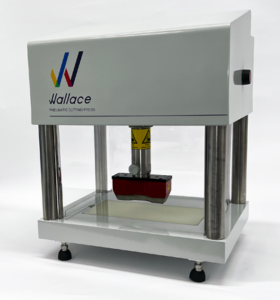
Wallace Instruments launches WAS3 pneumatic cutting press
Dorking, Surrey, UK – Wallace Instruments has launched the WAS3 Pneumatic Cutting Press, expanding its UK-manufactured specimen preparation range.
Pneumatic cutting presses offer significant advantages over manual alternatives in laboratory and production environments. Consistent cutting force is applied with every cycle, regardless of operator strength or fatigue, reducing variability in specimen quality across a working day or between different technicians. This consistency matters: poorly cut specimens – with ragged edges, inconsistent dimensions, or stress introduced during cutting – can compromise test results. Pneumatic operation also reduces the repetitive physical effort associated with manual pressing, supporting operator wellbeing over long production runs.
The WAS3 has been developed to deliver these benefits with a particular focus on practical safety. It is designed for single operator use with a two-button activation system that requires both buttons to be pressed within half a second, ensuring the press cannot be activated while the operator’s hands are in the cutting area. Protective guards on three sides further support safe operation.
Providing 15kN of cutting force, the WAS3 can cut through 10mm thick 95 Shore A rubber sheet with ease. It operates using a pressure of 5.0 bar from a filtered air supply and delivers consistent, user independent cuts without physical exertion, making it suitable for all technicians. The WAS3 is compatible with existing Wallace cutting dies, allowing laboratories to integrate it into their workflows without replacing their existing die sets. Its compact footprint fits easily into both laboratory and production environments.
“Specimen preparation is the foundation of accurate rubber testing,” said Chris Norval, Managing Director of Wallace Instruments. “With the WAS3 we focused on practical safety, dependable cutting performance and drop-in compatibility. Labs get a compact pneumatic press that fits the air lines already in place, uses their current Wallace dies and delivers consistent results for every operator – because when specimen quality is controlled, you can have confidence in the results that follow.”