
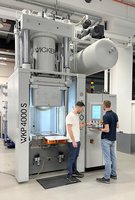
Wickert Maschinenbau delivers three WKP 4000 S vacuum chamber presses to J. Schmalz GmbH
Landau, Germany – Wickert Maschinenbau has delivered three WKP 4000 S vacuum chamber presses to J. Schmalz GmbH. Schmalz is using the presses at its new facility in Bydgoszcz, Poland, as well as in the technical center at its headquarters in Glatten, located in Germany’s Black Forest.
At the Bydgoszcz site, the presses are used to produce components for vacuum cups made from rubber and silicone—parts that are essential across various industries, including Wickert’s own press manufacturing operations.
The WKP 4000 S features heating plates measuring 600 x 600 mm and delivers a pressing force of 4,000 kilonewtons. Its vacuum chambers eliminate air inclusions during the pressing process, which can compromise product quality. This ensures that elastomer suction cups—ranging in size from 20 to 400 mm—are manufactured with high precision and consistency.
Markus Odermatt, Head of Production at Schmalz’s Plastics Center, praised the presses for their outstanding production quality, uniform temperature distribution, and robust “Made in Germany” engineering. He also highlighted Wickert’s customer-focused approach: Wickert tailored the presses precisely to our product range and requirements.
Special features such as internal lighting, central discharge, and an integrated compressed air booster were implemented quickly. Odermatt also noted the benefits of the fixed piping system: it eliminates the risk of hose ruptures, reduces wear, and enhances safety.
A major factor in the investment decision was the fixed working height of the upper piston presses. As Schmalz began producing larger elastomer parts, the variable working heights of older machines became increasingly difficult for employees to manage. Odermatt emphasized that ergonomics are important to them, which is why they paid special attention to this aspect.
Wickert delivered and installed the presses at the end of 2023, expanding Schmalz’s production capacity and clamping force range. Dominik Haug, from Schmalz’s Global Operations Network, particularly values the remote access feature. A technician at Wickert’s headquarters in Landau can operate the machines in Bydgoszcz—1,000 kilometers away—if needed.
He also noted that on-site visits are now simpler, thanks to easy car access and no language barriers. The bilingual user interface is another plus: switching between Polish and German makes communication with Polish colleagues much easier.
At its technical center, Schmalz uses the press for prototyping, tool testing, and evaluating technical improvements. An integrated monitoring system even tracks energy consumption per part—something Odermatt sees as a promising feature for the future.
Wickert has long used Schmalz vacuum cups for material handling in its own presses. Now, the roles are reversed, with Schmalz becoming a Wickert customer. For Steve Büchner, Sales Engineer at Wickert, the relationship goes beyond a typical supplier-client dynamic. He says they share a commitment to quality and innovation, which makes the collaboration especially rewarding.