
Patents for October 2025
Patent News as compiled by our editors for the October issue of Rubber World.
Fluorinated Copolymer Composition, Crosslinked Rubber and Method for Its Production
U.S. Patent 12,264,238, issued April 1, 2025 to inventors Yukiko Hattori, Tsuyoshi Kawai, Takeshi Yamada, and Takehiro Kose and assigned to AGC, describes a method for producing crosslinked rubber with high hardness and transparency. The method uses a fluorinated copolymer composed of tetrafluoroethylene and perfluoro(alkyl vinyl ether) units, together with controlled amounts of crosslinking agent and coagent.
Fully Bio-Based, Highly Filled Lignin–Rubber Masterbatch, Method for Preparing Same and Use Thereof
U.S. Patent 12,269,952, issued April 8, 2025 to Chenjie Zhu, Haifeng Liu, Ming Li, Lei Ji, Zhiwei Chang, Yixin Feng, Zhuotao Tan, Tao Shen, and Hanjie Ying and assigned to Nanjin Tech University, discloses a sustainable lignin–rubber masterbatch. It is prepared by modifying lignin with acetic and oleic acids before blending it with rubber. This material can replace carbon black as a reinforcing agent and offers improved mechanical properties and cost savings.
Sulfur Modified Chloroprene Rubber and Method for Producing Same, Sulfur Modified Chloroprene Rubber Composition, Vulcanizate and Molded Article
U.S. Patent 12,269,904, issued April 8, 2025 to Atsunori Kondo and Takashi Sunada and assigned to Denka, presents a sulfur-modified chloroprene rubber containing specific terminal functional groups. The ratio and total content of these groups are precisely defined to improve rubber performance.
Fluorine Containing Elastomer Composition and Method for Making Cured Fluorine Containing Elastomer Composition
U.S. Patent 12,275,832, issued April 15, 2025 to Chung-Ming Huang, Ren-Guan Duan, Chen-Hsiang Lu, and Tien-Chih Cheng and assigned to Taiwan Semiconductor Manufacturing, describes a fluorine-containing elastomer composition. It includes a curable fluorinated polymer, a group IIIB element-based reinforcing additive, and a curative to form a durable cured elastomer.
Synthetic Enzyme Complexes for In Vitro Rubber Production
U.S. Patent 12,275,974, issued April 15, 2025 to Grisel P. Ponciano, Colleen M. McMahan, Paul Hoeprich, and Patrick Scannon and assigned to the United States Secretary of Agriculture, discloses recombinant enzyme systems from rubber-producing plants. These enzyme complexes enable natural rubber production outside plant tissues.
Diene Rubber and Rubber Composition
U.S. Patent 12,275,845, issued April 15, 2025 to Yoshikazu Ueno and Daisuke Koda and assigned to Kuraray, introduces a diene rubber formulation designed for high ice and wet grip performance. The rubber contains specific butadiene structures and molecular weight characteristics, making it suitable for tire applications and resin compositions.
Additive for Rubber Compounds and Method for Producing Same
U.S. Patent 12,281,214, issued April 22, 2025 to Mikhail Rudolfovich Predtechenskiy, Alexandr Alexandrovich Khasin, Ruslan Vladimirovich Karpunin, Andrey Yurievich Skuratov, Ilya Anatolyevich Filippov, Angelina Nikolaevna Anufrieva, and Vladimir Andreevich Kruch and assigned to MCD Technologies, relates to an additive that improves electrical conductivity and mechanical properties of rubber. It contains carbon nanotubes, high-viscosity organic rubber, and a dispersion medium, along with a method for its preparation.
Chain Control Device with Elastomer Face Overmolded Using Two-Shot Injection Molding
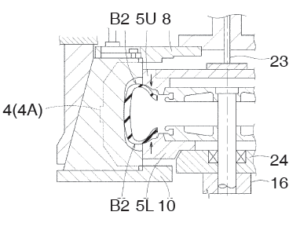
U.S. Patent 12,275,172, issued April 15, 2025 to Philippe Alain Clayton and assigned to BorgWarner, covers a manufacturing method for chain control components such as tensioner arms and chain guides. These components are produced using two-shot injection molding, combining a thermoplastic or thermoset body with an overmolded elastomer sliding face.
Rubber Composition for Torsional Damper
U.S. Patent 12,281,222, issued April 22, 2025 to Tetsuro Negami and assigned to NOK, discloses a rubber composition intended for torsional dampers. The composition includes defined amounts of carbon black and a liquid polyolefin oligomer blended with ethylene-based rubbers, achieving targeted mechanical performance.